On the ground in the medina
Plaza Uta el-Hammam: what to see
Plaza Uta el-Hammam, the kasbah, Ras el-Maa and the Spanish Mosque: what each stop is, what fits in four hours, and what to know before you walk up.
See Chefchaouen tickets on GetYourGuide ↗Quick answer
Plaza Uta el-Hammam is the main square of Chefchaouen's medina, ringed by the kasbah, the Great Mosque and cafés. Start there, visit the kasbah and its museum, walk the blue lanes, then finish at the Ras el-Maa spring. That loop fits the roughly four free hours of a day trip. The Spanish Mosque viewpoint on its hill is the one stop that competes for your time.
The core stops
| Stop | What it is |
|---|---|
| Plaza Uta el-Hammam | Main square, fountain, cafés |
| The kasbah | Rammed-earth fortress, museum |
| Great Mosque | Octagonal minaret, no entry |
| Ras el-Maa | Spring east of the medina |
| Spanish Mosque | Disused, hilltop lookout |
What the square is
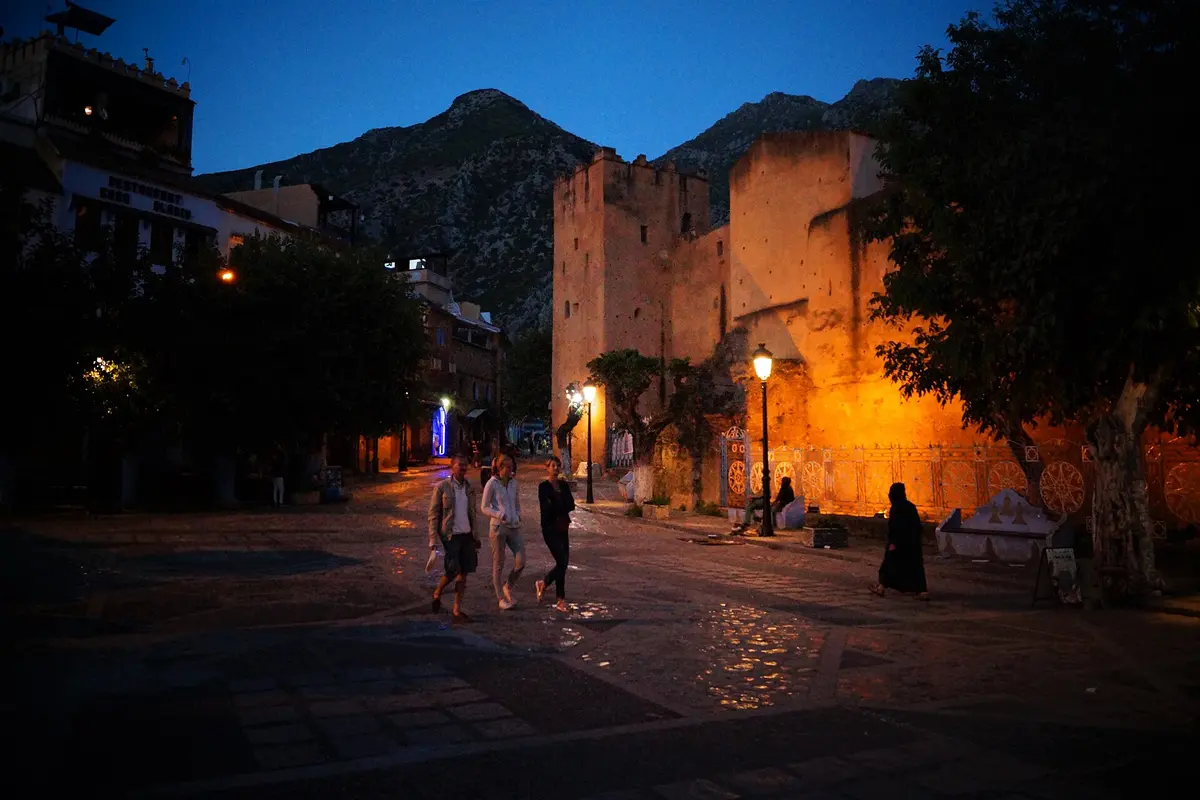
Plaza Uta el-Hammam, also written Outa el Hammam or Uta Hammam, is the heart of the medina. It is a market square surrounded by the most important buildings of the old town: the kasbah, the Great Mosque and a caravanserai, along with shops and cafés. A four-sided fountain stands at its centre. The square takes its name from a hammam, a public bathhouse, in its northwest corner, and it was probably laid out in the 16th century. Don't confuse it with El Haouta square, a smaller square with a traditional fountain.
Read next: Why is Chefchaouen blue? The competing explanations
The kasbah
The kasbah is the oldest part of the medina, the fortress that Chefchaouen grew from in the late 15th century. Its enclosure is walled in rammed earth and reinforced by ten towers, with a taller tower on the west side that was probably built in the early 16th century. You enter through an opening made in the 1930s, not through the original gates. Inside, a garden fills the courtyard, and a small museum shows archaeological and ethnographic objects in a historic house in the northeast corner. The entrance fee is not part of the day trip.
The Great Mosque
The Great Mosque stands on the square beside the kasbah. It is the oldest and historically most important mosque in town. The minaret is the part to look at: it has an octagonal shaft, decorated in three tiers of blind arches, with zellij tile panels on the highest tier. The rest of the mosque is largely undecorated. Non-Muslims cannot go inside, so you will see it from the square. It was most recently restored in 2006. Sources disagree about the exact year it was founded, so we leave it at the early days of the town.
Ras el-Maa
Ras el-Maa is the spring just east of the medina, outside its former walls, and it was the town's original source of water. Today the spot where the water comes out is enclosed in a stone structure. Downstream you will find an old mill and a bridge that may date from the 19th century. Residents meet here and wash laundry, and a café sits above the spring. It is a good place to slow down after the busy square, and a natural point to turn back toward the lanes.
The Spanish Mosque viewpoint
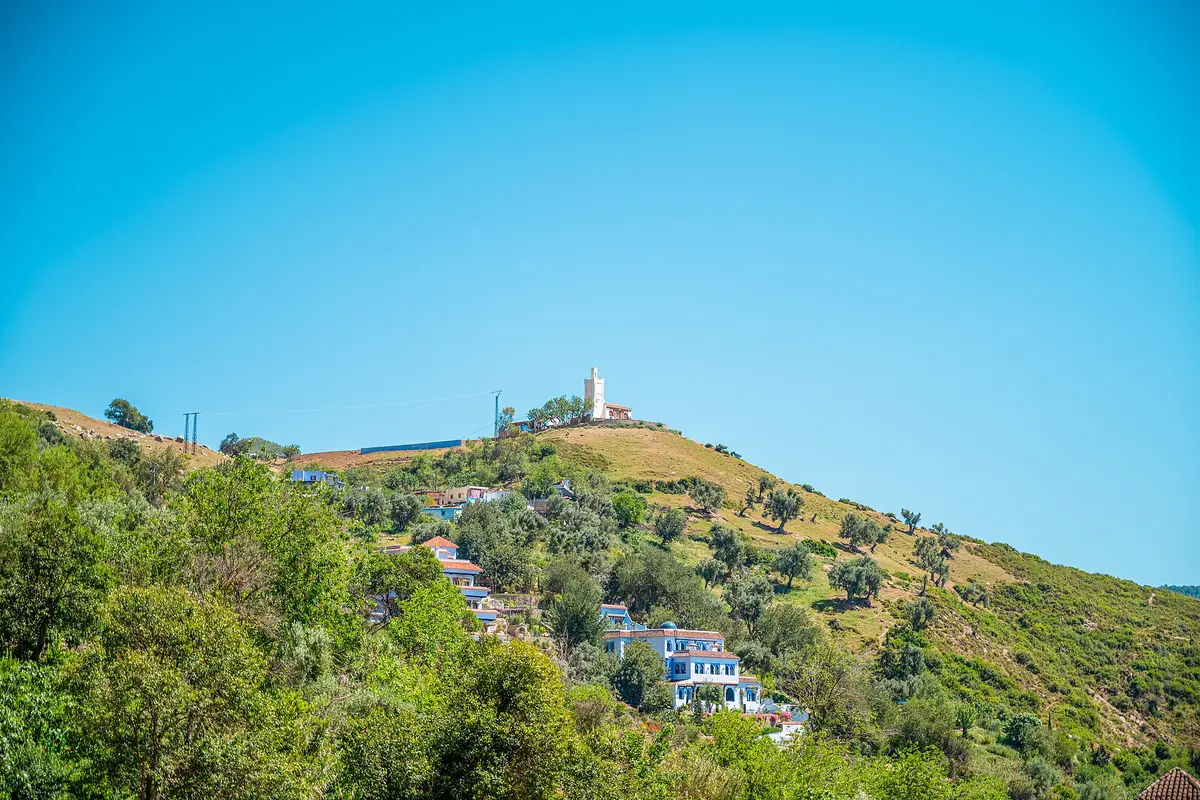
The Spanish Mosque stands on a hill east of the town, behind Ras el-Maa. The Spanish built it in the 1920s. It is disused as a mosque and is now a popular lookout, often visited at sunset. A trail leads on from it to another mosque further uphill. Allow real time for the climb, and check your meeting time before you set off. On a day trip with a fixed return, this is the one stop where you can easily run out of time.
What fits in about four hours
The day trip gives about four hours of free time in Chefchaouen. A simple loop keeps you near the centre: the square first to get your bearings, then the kasbah and its museum, a slow walk through the blue lanes, and finally Ras el-Maa. That fits in the time at an easy pace. The Spanish Mosque can replace the lanes or the museum, but doing everything is a stretch. Lunch is not included, and the cafés and restaurants around the square serve food. Summer is the busiest season, so expect more people then.
Quieter corners off the square
Beyond the main square, the Souika quarter southwest of the kasbah is one of the oldest neighbourhoods, dating from the 15th century. Its name means Little Souk, after the market that grew up there, and one old archway from its original gates remains. The medina also has several traditional fountains, including the Aïn Souika fountain, an old wall fountain set behind an archway. These corners are a gentle way to leave the square without climbing far, and they fit inside the same four hours.
Shoes, slopes and children
Chefchaouen sits at about 600 metres in the Rif foothills, and the medina is built on rugged slopes, so wear comfortable shoes, as the booking page advises. The climate is Mediterranean and yearly rainfall has varied a great deal, so carry a light layer. Keep some money for lunch and the museum, because neither is part of the trip. The booking page marks the trip as wheelchair accessible, so ask the operator what that covers. It is a long day, with about four hours each way in a vehicle, so ask about breaks if you travel with young children.
Language, photos and touts
Arabic is the first language of nearly everyone in town. Spanish and French are the most common foreign languages, and your driver speaks English and French. People live in the lanes you will photograph, so ask before you photograph anyone. Travellers report persistent touts and self-styled guides, mainly near the bus station and in the busier parts of the medina; a smile and a repeated polite no usually works. Cannabis is illegal in Morocco even though it is grown in the surrounding region, so do not buy it if offered.
Read next: Etiquette, photography and Chefchaouen as a lived-in town
A short history of the town
Chefchaouen was founded in 1471 as a small kasbah, built to help defend the area against Portuguese attacks on northern Morocco. Muslims, Moriscos and Jews fleeing Spain and Portugal during and after the Reconquista settled here and built quarters in the Andalusi style. Spanish forces occupied the town in October 1920. It briefly formed part of the Republic of the Rif in the mid-1920s, was retaken by Spain in 1926, and passed back to Morocco in 1956. Today about 46,000 people live in the municipality.
Who this isn't for
If you want someone to explain the history as you walk, this trip won't do that, because it has a driver and no local guide. If you want to spend an evening in Chefchaouen, stay overnight and arrive by bus instead. If you want to watch the sunset from the Spanish Mosque, a fixed return departure makes that hard. And if you hoped to see inside the Great Mosque, it is closed to non-Muslims.
Frequently asked questions
Where is Plaza Uta el-Hammam?
It is the main square of Chefchaouen's medina, next to the kasbah and the Great Mosque. Spellings vary: Outa el Hammam, Uta Hammam and Place Outa el-Hammam all refer to the same square.
What is Plaza Uta el-Hammam named after?
A hammam, a public bathhouse, that stood in the square's northwest corner. The square itself is a market square with a four-sided fountain in the middle, and it was probably laid out in the 16th century.
Can I go inside the kasbah?
Yes. The kasbah is a museum with a garden courtyard, and it charges an entrance fee. The day trip does not cover entrance fees, so you pay at the door if you want to go in.
Can I enter the Great Mosque?
No. The Great Mosque is off limits to non-Muslims. You can still see its octagonal minaret from Plaza Uta el-Hammam, which is the most decorated part of the building.
How long do I need in Chefchaouen?
About four hours covers the square, the kasbah, the lanes and Ras el-Maa at an easy pace. Add the Spanish Mosque only if you have time to spare, since the climb up takes real time.
Are there touts in Chefchaouen?
Travellers report them, mainly at the bus station and in busier parts of the medina. A polite, repeated no works. Don't follow anyone offering to find your hotel or sell cannabis, which is illegal.
Sources